
The 2026 Tariff Trap: Why Your Back-Office Strategy is the Missing Link
We are standing at a unique and precarious precipice in the global supply chain, one where the margins for error are shrinking faster than ever before. As we head rapidly toward 2026, two massive, opposing forces are colliding to create a volatile operational environment: the aggressive, regulation-heavy “America First 2.0” trade agenda and the frantic, speed-obsessed rush to adopt artificial intelligence across every layer of logistics. While logistics leaders and supply chain executives are racing to automate customs entry and documentation to cut costs and improve throughput, they are discovering a critical, often expensive vulnerability: without a modernized, human-led back-office to oversee these complex transitions, relying solely on AI is creating dangerous financial and legal risks. It sounds like the perfect efficiency play to let algorithms handle the boring paperwork, but as many are learning the hard way, the “AI Accountability Gap” is a trap. In an era where a single tariff misclassification can freeze a shipment for weeks or trigger a federal audit, the assumption that technology alone can navigate the nuance of international law is a fallacy that only human expertise can disarm.
Get a Free, No-Obligation Quote

The “Perfect Storm” Facing Your Back-Office Operations
The landscape of logistics is shifting beneath our feet, and the traditional goals of back-office efficiency—primarily simple labor arbitrage—are no longer sufficient for the complex challenges of 2026. For decades, the primary strategy for logistics companies was straightforward: send simple, repetitive tasks away to get them done cheaper. But as we approach the 2026 fiscal year, the rules of the game are changing fundamentally. The United States is signaling a return to aggressive protectionist policies, most notably the mandatory 6-year review of the USMCA (United States-Mexico-Canada Agreement) scheduled for July 2026. This isn’t just a rubber-stamp meeting; analysts predict it will bring stricter “Rules of Origin,” particularly for the automotive and manufacturing sectors, and potentially new baseline tariffs of 10-20% on goods that even slightly deviate from compliance. For more details on the projected 2026 trade policy shifts, read this analysis by
At the same time, the reliance on “black box” AI tools to categorize goods is creating a dangerous blind spot in your operations. AI models are probabilistic engines—they guess the right answer based on patterns in historical data. But 2026 introduces new rules that have no history for the AI to learn from. When a new tariff rule is introduced overnight, an AI model trained on 2024 data might confidently apply an obsolete code, unaware that the regulation has shifted. Without a back-office expert in the loop to catch these context-blind errors, that “efficiency” becomes a liability. A single misclassification doesn’t just mean a rejected shipment; it flags your entire company for audit by Customs and Border Protection (CBP), turning a $50 administrative savings into a $50,000 legal headache.
Redefining Back-Office Outsourcing as “AI Supervision”
This new reality requires a shift in mindset; we must stop viewing back-office teams as mere data processors and start viewing them as “AI Supervisors” essential to compliance. In the old model, you hired an outsourced team to do the work; in the new model, you use technology to do the work, and you hire an outsourced team to audit the work. This distinction is critical because AI often lacks “common sense” in ways that are disastrous for trade.
Consider the famous “Skye Body Suit” case from the UK, where an automated system misclassified a shipment of women’s bodysuits labeled “Skye Body Suit Champagne” as actual “Champagne” alcohol. Because the AI saw the word “Champagne,” it applied the excise duty for alcohol rather than the tariff for clothing. A human back-office agent would have spotted this instantly—an AI did not.
This “Human-in-the-Loop” (HITL) approach is the only safety net against the high cost of such hallucinations. In the manufacturing sector, we see “ghost parts”—where AI schedulers hallucinate inventory that doesn’t exist, stalling production lines. In customs, if your AI classifies a component as a “bearing” (subject to high anti-dumping duties) instead of a “transmission part” (duty-free) because they look similar in a schematic, the fines can be 200-400% of the value of the goods. By positioning your back-office staff as the final checkpoint, you ensure that the speed of automation doesn’t outpace the accuracy of your legal compliance, protecting your margins from avoidable penalties.
The Strategic Value of Human-Led Back-Office Compliance
When you integrate human expertise into your automation workflows, your back-office becomes a strategic asset that offers agility in the face of shifting trade policies. An AI model is static until it is retrained; it requires software patches, vendor updates, or massive new datasets to handle new regulations, a process that can take weeks or even months. In the volatile trade environment of 2026, you do not have weeks.
In contrast, a human team can read a new USMCA policy memo at 9:00 AM and implement it by 9:05 AM. Furthermore, human back-office experts possess contextual judgment that software simply cannot replicate. They know that a “server rack” imported for a massive data center has a different tax implication than one imported for a telecommunications facility, a nuance often lost on an algorithm that only reads keywords. This judgment saves costs and avoids the “failure to exercise reasonable care” penalties that CBP aggressively enforces.
Moreover, this human layer adds a defense against “concept drift,” where the data your AI uses slowly becomes irrelevant. As global supply chains reroute to avoid tariffs—moving from China to Vietnam or Mexico—the documentation changes language and format. Your back-office team bridges this gap, interpreting the new, messy reality of supplier invoices that would otherwise confuse your automated systems.
Overcoming the “Automation is Enough” Myth
A common objection we hear is, “Won’t the AI eventually get good enough to do this alone?” Perhaps one day, but relying on that hope for the 2026 fiscal year ignores the critical role that a specialized back-office plays in mitigating current risks. There is a pervasive myth that Generative AI is a “set it and forget it” solution.
The reality is that the error rate of generative AI in complex legal and compliance tasks is still too high for federal standards. We have seen lawyers sanctioned for citing fake court cases generated by ChatGPT; imagine the consequences of citing fake tariff codes to the federal government. Relying solely on software is like flying a plane on autopilot through a hurricane—it works fine until it doesn’t. A skilled back-office team acts as the pilot who takes the controls when the turbulence hits. They handle the exceptions, the anomalies, and the “gray areas” where the text of the law is ambiguous. Without them, you are flying blind into a regulatory storm, hoping your autopilot doesn’t crash your supply chain.
How Valoroo Helps: Your Compliance Pilots
This is where Valoroo steps in. We don’t just provide “staff”; we provide the back-office safety layer your technology stack is currently missing. We position our nearshore teams in Mexico and Belize not as simple support, but as your dedicated “Compliance Pilots.”
Because our talent is located in close proximity to the US market and operates in your time zone, they are uniquely positioned to handle the real-time pressures of cross-border logistics. They utilize a modern back-office approach to understand the nuance of North American trade because they are part of the North American trade ecosystem. Learn more about how nearshoring enhances operational speed in our recent post on
The Valoroo Solution
Our approach is designed to close the AI accountability gap:
- AI Output Auditing: Our teams review the tariff codes and documentation generated by your AI tools, catching “hallucinations” before they become fines.
- Exception Management: When the AI flags a complex shipment it can’t handle—like a mixed-origin kit subject to USMCA rules—our skilled agents step in to resolve the anomaly.
- Regulatory Agility: As 2026 trade policies evolve, our teams adapt immediately, ensuring your compliance doesn’t lag behind the headlines.
- Bilingual Nuance: Our agents in Mexico and Belize offer bilingual support, crucial for interpreting supplier invoices and documentation from Latin American partners that English-only AI models frequently mistranslate.
Frequently Asked Questions (FAQ)
Q: Why can't I just trust my ERP's AI features for tariff classification?
A: Most ERP AI features are trained on historical data. When new “America First 2.0” tariffs are implemented in 2026, that historical data becomes obsolete. AI lacks the judgment to interpret new, nuanced legal definitions without human guidance.
Q: How does "Human-in-the-Loop" outsourcing save money?
A: While it adds a layer of labor, it prevents the exponential costs of non-compliance. One missed tariff declaration can result in penalties that far exceed the annual cost of a dedicated team. It acts as an insurance policy for your automated workflows.
Q: Why is nearshoring better than offshoring for this type of work?
A: Time zone alignment and cultural proximity are critical for compliance. When a shipment is stuck at the border at 2 PM EST, you need a team that is online and awake to resolve it immediately, not a team that is just waking up 12 hours away.
Conclusion
As we move into 2026, the companies that win won’t just be the ones with the fastest tech—they will be the ones with the safest processes. The combination of stricter tariffs and faster AI creates a volatile environment where mistakes are easy to make and expensive to fix.
Your tech stack moves the data, but your back-office team keeps it legal. Don’t leave your compliance to chance (or a chatbot). Would you like me to connect you with a Valoroo specialist to discuss how a “Compliance Pilot” team can safeguard your operations against 2026 tariff risks?
Related Posts

Valoroo Cares Iloilo
Valoroo Cares Iloilo: How Our Philippine Team Gave a Local School a Fresh StartValoroo Cares Iloilo is what it looks like when a company backs its own people's ideas: on September 6, 2026, Valoroo funded a full classroom makeover, computers, an air conditioning unit,...
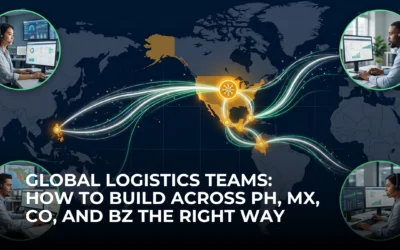
Global Logistics Teams: PH, MX, CO, and BZ Compared
Logistics Outsourcing vs In-House: Real Differences That Affect Your MarginBuilding global logistics teams is no longer a fringe strategy reserved for enterprise operators with dedicated HR infrastructure and six-figure implementation budgets. Mid-market freight...
Logistics Outsourcing 2026: Why It’s No Longer Optional
Logistics Outsourcing vs In-House: Real Differences That Affect Your MarginLogistics outsourcing 2026 has crossed a line that most operators haven't fully acknowledged yet. It's no longer a cost-cutting move made by companies trying to trim overhead. It's the...
Learn what makes our dedicated team model different and why it succeeds.
Locations
Address: 10350 N McCarran Blvd #1112. Reno, NV 89503
Phone: (858) 251-1210
Email: info@valoroo.com